We all have a surname and might have heard about coats of arms or family crests, but what are they, where did they originate, and why might they be important?
Each one, surname, coat of arms and family crest, tells a story of a family name. They say it more concisely than many words and they stand the test of time.
What is a Surname?
The simplest definition of a surname is a name born in common by members of a family. It is the most hereditary portion of one’s personal name that indicates their family and is generally combined with a given name to form the full name of a person. The majority of surnames are derived from patronymics. For example, the forming of the father’s given name such as Carlson, meaning literally “the son of Carl.” The acquisition of surnames has been affected by many factors such as social class and structure, cultural traditions or even naming practices.
Most European surnames began to appear after the Norman Conquest in 1066. Prior to this people were largely illiterate, lived in rural farming communities or small villages, and had little distinction beyond their given names. To differentiate individuals who had the same name locally, communities might refer to them as William the baker or William the blacksmith. Still, these could be dropped or changed at will. However, by 1381, as is evidenced by Richard II’s Poll Tax lists, nearly all English families adopted the use of hereditary surnames.
Coat of Arms
In simplest terms, a coat of arms is a symbol used to identify a family or an individual. While they aren’t as common nowadays, throughout history they were very important for establishing who was on what side of a certain conflict and more.
Coats of arms can contain many different symbols within their elaborate design, such as a shield, crest, helmet, weapons, or even a saying representing the family motto.
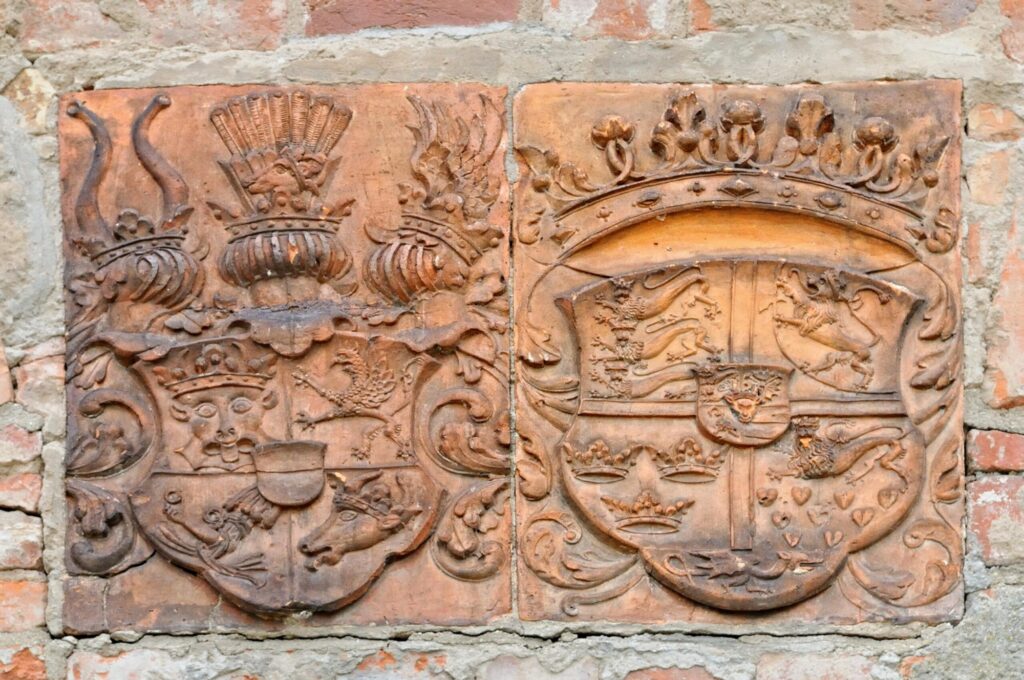
The coat of arms dates to early medieval Europe and is the principal part of an arrangement of hereditary symbols used primarily to establish identity in battle. Over time, the arms evolved to denote family descent, adoption, alliance, property ownership and profession. The origin of the term is in the surcoat, the cloth tunic worn over armor to shield it from the sun’s rays. It was then repeated on the banner or pennon (triangular flag) and on the shield of the bearer’s arms. The symbols helped identify a knight in the social surroundings of a tournament and would assist identifying them during or after a battle. It was often the case that as alliances were formed through marriages and peace treaties, the new alliance would be reflected in the coat of arms.
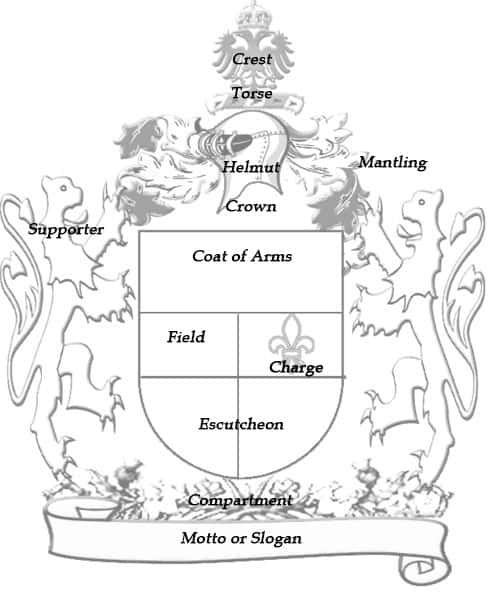
The arrangement of heraldry is a full display of all the achievements the bearer is entitled to. Not only is the coat of arms displayed on the escutcheon (i.e. shield), the central element, but the following elements are also displayed. Starting from top to bottom, the crest is an apparatus located on top of the helmet. In ancient Rome, feathers or horsehair were used to showcase an officer’s rank. At the base of the crest is a circlet of twisted cloth known as a torse. Some arrangements include a crown but under strict rules. The crown atop the shield signified the status of its owner. Forming a backdrop for the shield, mantling is a drapery tied to the helmet and is a depiction of the protective cloth worn by nights to stave off the elements. It would be comprised of one or more colors, metals or furs. On either side of the shield would stand supporters or attendants, appearing to hold the shield up. Within the shield itself are the field and the charge. The field is the background of the shield and is generally comprised of colors or furs. The charge is an emblem that occupies the field. It could be a design or a symbolic representation of a person, animal, plant or object. Underneath the shield is the compartment which is usually some type of landscape that the supporters stand on. The final element of heraldry would be the motto or phrase that might express a belief or purpose. Each one of these symbols or elements tells the story of the origin of the arms.
By the 12th century the use of coats of arms became more common. By the 13th century families were using coats of arms as the family logo and would be sewn onto flags that flew above their properties. During medieval Europe, coats of arms were only used by the highest classes of people as they were distinguished enough to have been granted them by the kings of the time. If a family began using a coat of arms, it was passed down through the generations, even down to the present day. As time went by, even nations and corporations adopted their own coat of arms.
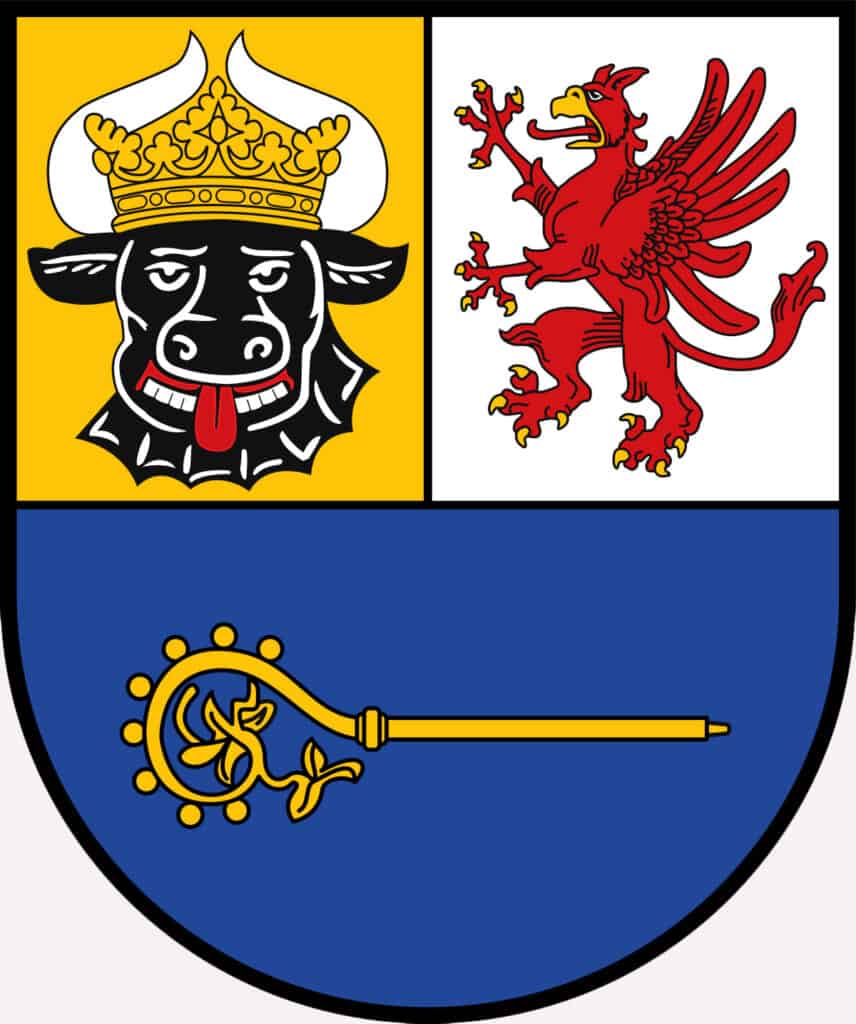
Dargun Coat of Arms
Dargun, a town in the Mecklenburgische Seenplatte district, in Mecklenburg-Western Pomerania, Germany, is the birthplace of many of my ancestors. Within the exterior walls of Dargun Castle has existed a coat of arms. It wasn’t until November 9, 1875, that the arms were officially granted to the town. The crozier (hooked staff carried by a bishop) alludes to the Cistercians, whose monastery of Röcknitz, first mentioned in 1178, was the settlement core of the city established later on. The mythical creature griffin of Pomerania is a reminder that the city once belonged to Pomerania from 1236 to 1291. Finally the bull’s head symbolizes that the city has belonged to Mecklenburg-Schwerin since 1815.
How is the Family Crest Different From the Coat of Arms?
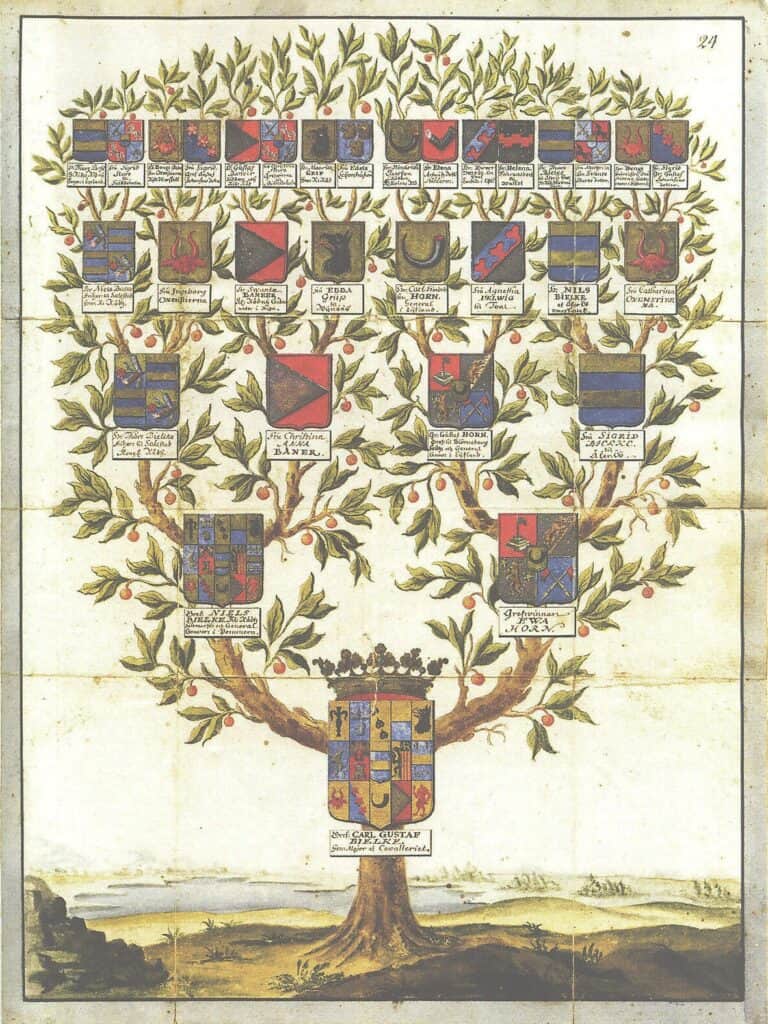
A crest is a simplified symbol used to represent a family. This crest, called the family crest, is almost always a small portion of a large coat of arms. As centuries passed, the original meaning of the crest was often forgotten, and it simply became an identifying symbol for a family of high rank or nobility.
The reason these are often portrayed as separate things is that while the knight would have the coat of arms on his shield heading into battle, that design was just too intricate to put on every piece of his armor in the case he was separated from his shield. For this reason, the simplified coat of arms, called the crest, was placed on the sword and helmet of the knight.
What Families Can Have a Family Crest or Coat of Arms?
Does every family have a family crest or a coat of arms? The short answer is no. Only a few individuals are legally entitled to use ancient heraldry. There are many families with the surname Spencer but that does not automatically grant them the right to use the Spencer family’s coat of arms. That being said, if the family can prove the surname through the male-line ancestry and examine official records granting permission of that surname to use a coat of arms, a claim might be made. So beware of the many online companies claiming to research family surnames and their associated family crests or coat of arms along with merchandise showcasing these symbols. Because unless they can prove the ancestral lineage, it is highly likely they selling the modern version of snake-oil. Honestly though, who wouldn’t like a coffee mug with their family surname and supposed family crest on it?